INTERNATIONAL JOURNAL PUBLICATIONS IN ACADEMIC EDUCATION AND RESEARCH (IJPAER)
Internation Journal Publications in Academics Education and Research (IJPAER) is a non-profit, global, a professional association with a mission to build and sustain partnership between technical & management professionals, government, non government organizations, business and academic institutions, to address people to meet the challenges that impact on education systems and serve community.
IJPAER is a scholarly open access, peer-reviewed, interdisciplinary, tri-monthly and fully refereed journal focusing on theories, methods and applications in:-
- IJPAER-CSE
- IJPAER-Management Studies
- IJPAER-Education Technology
- IJPAER-English Studies
- IJPAER-Environment Science
- IJPAER-Physical Education
- IJPAER-Applied Science
- IJPAER-Hindi
- IJPAER-Geography
IJPAER has earned a name for itself as a leading educational and research publication and is fast developing as an academic and research platform for traditional as well as professional studies. Presently, it offers education and research Publication through 08 streams in on-line mode. IJPAER is an important on-line publication for disseminating knowledge in various streams. This is a publication of general education, engineering, technology, computer science and management spread over World Wide Web. Over the years, the IJPAER has made rapid strides in academics research and publication.
AIM AND SCOPE
With an objective to promote inter-disciplinary higher education and research in the fields of computer Science and Engineering, Electronics Engineering, Electrical Engineering, Mechanical Engineering, Management Studies, Environment, Education, English, Hindi and Literature, IJPAER has been established.
The journal aims to maintain a rapid editorial procedure and a rigorous peer-review system. The submitted articles are peer-reviewed within a period of submission and the accepted articles are published on the internet immediately upon receiving the final versions. All accepted articles are published electronically on IJPAER web site.
- To provide a platform where academicians, research scholars and students can meet at the same platform and share advancements in research and development in their research area.
- To provide thought leadership, education and research in the areas of Management, Technical Education and general Studies.
- To conduct awareness programs, workshops, conferences, Seminars etc. to promote education and research globally.
- Publishing useful literary works for the welfare and development of research in Higher Education.
- To enhance professional ideals & standards ideas in general studies, Technology and Management areas.
WHY YOU SHOULD PUBLICATION WITH US
This is a International publication and your research work and publication is asseciable through out world.
PUBLICATIONS AND AUTHOR'S EXPERIENCES
This is a International publication and your research work and publication is asseciable through out world.The author's research work and publication goes through various phases which are described below.
A.) Peer Review and Editorial Decision Making at IJAER
The peer review process is essentially a quality control mechanism. It is a process by which experts evaluate scholarly works, and its objective is to ensure a high quality of published science. However, peer reviewers do not make the decision to accept or reject papers. At most, they recommend a decision. At peer-reviewed journals, decision-making authority rests solely with journal editors or the journal�s editorial board. Indeed, it is the journal editor who is considered to be central to the decision making process.
B.) Journal Decision-Making Process
Typically, after a paper is submitted to a journal, a journal editor screens the manuscript and decides whether or not to send it for full peer review. Only after clearing the initial screening is the manuscript sent to one or more peer reviewers. Finally, journal editors or the journal�s editorial board consider the peer reviewers� reports and make the final decision to accept or reject the manuscript for publication.
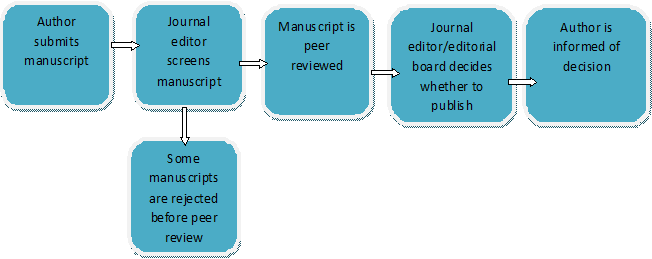
C.) Initial Screening
Approximately 3 million manuscripts are submitted to journals every year. Given the large volume of manuscript submissions, more and more journals follow a policy of screening papers before sending them for full peer review. During the initial screening, journal editors mainly check the following:
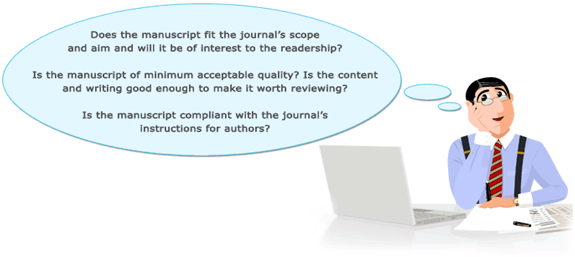
Journal editors typically look at hundreds of manuscripts a year. One of the first items that editors will look at is the cover letter, and they may not get further than the cover letter if the study does not seem interesting enough. Therefore, it is imperative that authors craft a well-written cover letter that highlights the significance and strength of their research as well as provides a good reason why the manuscript is a good fit for the journal. Editors will then go through the abstract and may even skim through the introduction, figures and tables, or other sections of the paper to determine whether the manuscript passes their quality threshold.
D.) Benefits of Initial Screening
- If the manuscript clearly lies outside the scope of the journal, then a rapid rejection allows the author to quickly find and submit their manuscript to another journal.
- Peer reviewers� time is wasted when they have to spend time evaluating and giving feedback for a manuscript of clearly inferior quality.
E.) Did You Know?
Journal editors reject in-betweens 6% to 60% of submitted manuscripts at the initial screening stage. One study found that on average, 21% of submissions are rejected during the initial review by journal editors across disciplines.
Stay Up to Date With Whats Happening